

Meet Our Team
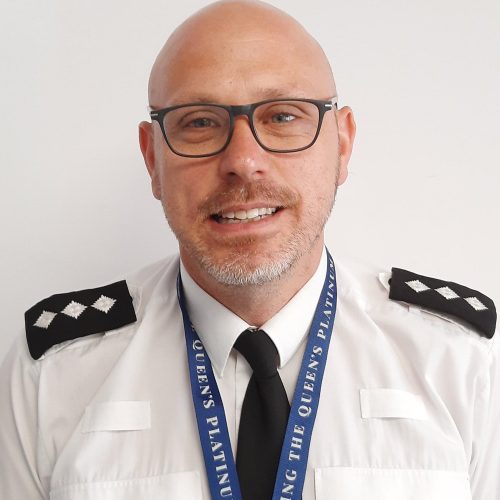
I grew up in Ryde and Newport, and from an early age I knew I wanted to serve my community. Becoming a police officer was always my ambition – I wanted to make a real difference in the place I call home. After serving in the Royal Air Force, policing felt like a natural next step. It’s a career built on discipline, teamwork, and public service – values I’ve always held close.
I joined Hampshire and Isle of Wight Constabulary in 2002 and was posted to Ryde after my initial training. Early on, I was involved in frontline policing, including the arrest of a knife-point robbery suspect who had targeted a vulnerable pensioner. That moment really reinforced why I do this job, to protect those who need us most.
Over the years, I’ve worked across neighbourhood policing and major incident management. I was part of the public order team that helped police the 2005 G7 Summit in Gleneagles – a high-profile operation that demanded precision, resilience, and coordination. As a Sergeant and later an Inspector, I’ve led responses to critical incidents across the Isle of Wight, always with a focus on keeping people safe and supporting my team.
I believe policing is unique. It’s not about individual effort – it’s about the strength of the team. We bring together different skills, backgrounds, and perspectives, and that’s what makes us effective. We work for each other, and for the communities we serve.
Now, as District Commander, my role is to support our teams in delivering outstanding local policing across the island. I’m proud to lead here, proud of the place, and proud of the people.
One of my proudest moments was laying the police wreath on Remembrance Sunday in St Thomas Square, Newport. It was a symbolic act that connected my service to the island’s history and values – something I’ll never forget.
To anyone thinking about joining us, my message is simple: if you care about your community, want to be part of something bigger, and are ready to grow – policing on the Isle of Wight is a career like no other.
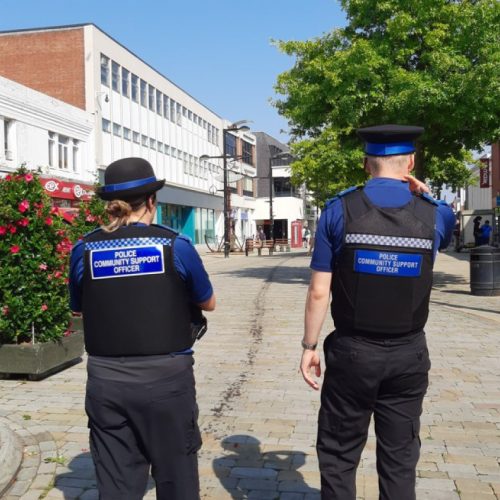
What is the difference between a police community support officer and a police officer?
The difference between PCSOs and PCs is primarily what we are involved with. PCSOs are not expected to respond with blue lights and sirens, nor take control of a situation where there could be a violent offender on scene. Police officers, carry a bigger work- load, like, they are required to write case files if a case is going to court.
PCSOs have more time within the community as we are less restricted, however we do still carry a work load and still become involved in the investigation side of things.
Another difference is that PCs carry handcuffs, tasers, batons and PAVA spray, meaning there is less expectation for PCSOs to get involved in conflict.
Police officers can be abstracted to cover other areas within the force or asked to cover other police forces.
What does a standard day look for you?
A standard day for me would be getting to work, checking emails and seeing what has happened in the area. We can access the police system that will tell us what crimes or incidents have taken place over the last few days.
I would then target my patrols and see any victims that need to be spoken to by police. This might be to gather CCTV or conduct house-to-house enquiries.
What advice would you give to someone considering becoming a PCSO?
Go for it. This is a very enjoyable career, no two days are the same and you get to feel like you have made a difference. You get to patrol some lovely areas and meet new people.
Can you introduce yourself and your role?
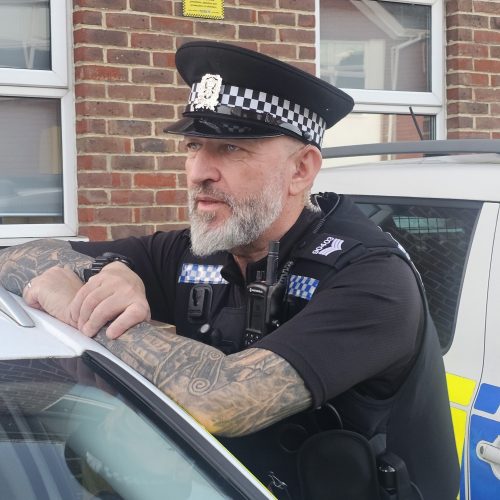
My name is Roger, and I’m currently a Special Sergeant with the District Policing Team on the Isle of Wight. I transferred to Hampshire & Isle of Wight Constabulary in November 2024, but I’ve been a special constable for over 20 years. My role as Special Sergeant is to support the special constables on the Island.
What does a typical shift look like?
There’s really no such thing as a ‘typical’ shift! Every duty is different. We respond to 999 calls, which can range from large-scale disturbances, domestic incidents, missing persons and anything else that requires a police presence, the list is endless. It always starts with a team briefing and a quick catch-up with colleagues—although sometimes the radio goes off before the kettle has boiled and you’re straight out the door!
How do you balance volunteering with your personal and work life?
I’m lucky to have a very supportive wife and an employer who is part of the Employer Supported Policing Scheme, which gives me time off for policing duties. My day job works on a 5-on, 5-off rota, which also gives me plenty of spare time. The minimum requirement for a ‘special’ is 16 hours a month, but I average about 70 hours. The more you put into the role the more you get out of it.
What skills do you think are important for the role?
I believe we all have the skills needed, we all want to help people. One quote I live by is: ‘Courage is not the absence of fear; it’s the ability to act in the presence of fear.’ To me, that means anyone can stand up for what’s right. It’s about tapping into your potential, completing your training, and developing your skills to help the community.
What’s the best part of being part of the Special Constabulary?
The impact you can have on someone’s life. Even if it’s just making a person feel safe, you go home knowing you’ve achieved something special. I think that’s why we’re called ‘special’ constables.
Can you tell us what it is like to work and live on the Isle of Wight?
I’m still very new to the Island and still getting used to the slower pace of life, being born in South London and starting my ‘specials’ journey in the Met I can already see that policing on the island is definitely a unique experience. Firstly, the majority of the residents are actually happy to see police officers which is something I didn’t experience often in London. Policing on the island is very personal as officers are part of that community as well, making the job extremely rewarding, but can also bring its own challenges when dealing with sensitive issues in a small population. Because we are isolated from mainland teams, having limited specialist units, Island officers rely on each other for support and need to be multi-skilled, often taking on a wide range of roles. It’s definitely the pinnacle of policing in the area you live in even my next-door neighbour is a police officer.
What advice would you give to someone considering becoming a special constable?
Fill out that application – you won’t regret it! I certainly haven’t. Over 20 years, I’ve had amazing experiences, met incredible people and made lifelong friends. Most importantly, it’s made me a better person.
Can you tell us about your role?
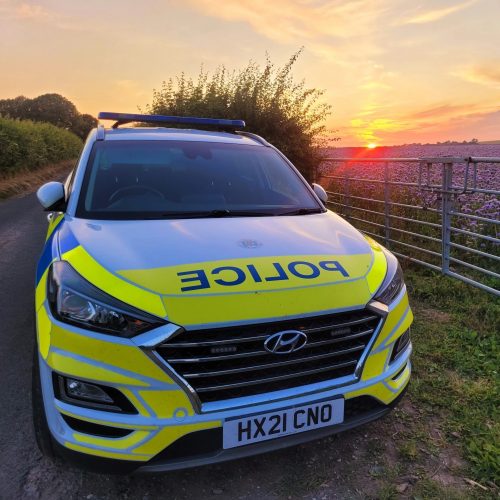
I’m a Police Constable on the District Policing Team on the Isle of Wight, responding to everything from 999 emergencies to 101 calls. That can mean dealing with offenders one moment and supporting vulnerable people the next, no two jobs are ever the same.
What does a typical day look like?
A typical day shift starts with me arriving at the station around 06:30, giving the night shift a well earned handover. We have our briefing at 07:00, then I work through the jobs already on my account while responding to new incidents coming in through the Contact Management Platform from 999 and 101 calls. Before finishing for the day, I make sure all my jobs are properly recorded and complete any remaining admin so everything is up to date.
What skills do you need?
Communication is vital – you may need to switch between being calm, assertive, reassuring, or in control depending on the situation. Teamwork and multitasking are also essential. Your shift becomes like a family, and you rely on each other in high pressure, sometimes lifesaving moments.
What’s the best part of the job?
I love the proactive work, from stop searches to warrants – especially when it leads to big results. But nothing beats helping victims and hearing that you’ve made a real difference. Having a brilliant team around you makes the job even better.
What’s it like working on the Isle of Wight?
I’ve lived on the Isle of Wight for most of my life. It’s a fantastic place to work, and I feel genuinely proud to police the community I grew up in. The island gives you such a mix of incidents – you never know what you’re heading to next. It can be challenging at times, especially when resources are stretched and we can’t call on extra officers as easily as the mainland, but I always remind myself to focus on what I can do. Give your best to every job, stay grounded, and never take any task for granted.
What advice would you give someone thinking of joining?
Keep going, even if you don’t get in first time. This job is an honour and an incredible opportunity to help people. It’s tough at times, so always speak up if you’re struggling – no one expects you to know everything. I joined at 19, and age doesn’t matter; what matters is your attitude. Policing gives you experiences and memories you won’t find anywhere else, and with so many different teams and roles, there’s always room to grow.
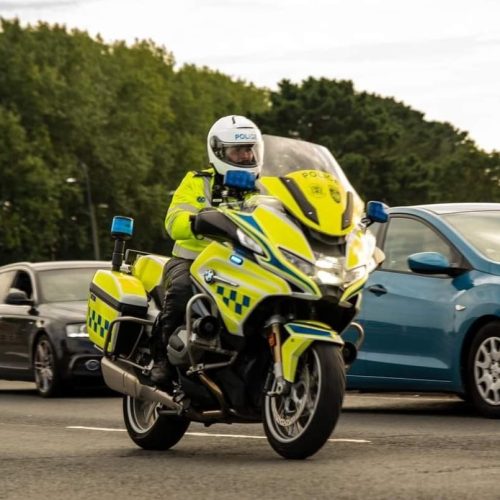
PC Hazel, is currently the only female motorcyclist in Hampshire and Isle of Wight Constabulary.
Tell us about your role?
I work as a Roads Policing Motorcyclist. My team and I work to keep the roads safe by targeting criminals using the transport network and investigating road fatalities.
What does this entail?
Responding to fatal and serious injury road collisions means we deal with the initial incident, which can involve giving lifesaving CPR, tending to catastrophic injuries or supporting witnesses at the scene with what they’ve seen.
We also keep the scene intact and work with our colleagues in Forensic Collision Investigation Unit (FCIU) to take photos, measure skid marks and scan to capture every aspect of the scene so it can be reconstructed later. The vehicles are recovered forensically or mechanically which enables DNA samples to be taken and testing to see if there’s anything wrong with it, such as brake issues.
Even after the scene is closed down, our job is not over. We investigate CCTV, witness statements and deploy a Family Liaison Officer (FLO) to support families through the investigation and court process.
Outside of responding, we also patrol high-priority roads; such as the M27 and A3; to reduce road traffic collisions where these are more likely to happen. We target people who use the road network to commit crime, deploying tactics to stop these vehicles and apprehend suspects.
Why did you join the Police?
My Mum was a police sergeant and I always thought she was cool. I joined as a police community support officer (PCSO). At the time I wanted to be a police constable (PC) in Hampshire, but they weren’t recruiting so I looked to transfer elsewhere. I joined the British Transport Police (BTP) in London as a PC. I spent 3 years there before being able to transfer back to Hampshire. After a year, I joined the Roads Policing Unit which was my dream role.
Did you always want to be a police motorcyclist?
My goal from when I was young was always to be a female motorcyclist. I knew it would take me a while to get the experience but worked my way onto the department and then showed my interest for bikes straight away. I believe there have been two women motorcyclists before me, but none since 2010 and I am the only female motorcyclist in Hampshire & Isle of Wight Constabulary currently. I had my doubts about riding the huge bikes but I hope other people see what I’m doing and it gives them the confidence to do it too.
Do you have any advice for women interested in becoming motorcycle officers?
I would say go for it. It is daunting and we do have to work harder in certain areas just because the bikes are so big and physically us girls are smaller! But practice makes perfect and there is nothing you can’t achieve that a man can. I am always happy for anyone to approach me and ask me for my tips on how I overcome the little hurdles!
How do you find being the only female officer in the team?
I am obviously immensely proud of myself, as to look at, I look like a typical girly girl (and yes my favourite colour is pink!) but I love shocking people that I am not the ‘normal’ biker. I want to get other women riding as I am so proud of how far we’ve come in the force – when my mum was an officer, she was given a handbag!!
What is different about being a motorcyclist to an advanced car driver?
I am an advanced motorcyclist and off-road motorcyclist. I love driving a car but there is nothing like riding a motorcycle. I see more on a bike. I see more offences, can fit through smaller gaps and get to places quicker. I also find it better to engage with other motorcyclists if I am on mine as well. The only downside to a bike is there’s no air-con when it’s really hot!!
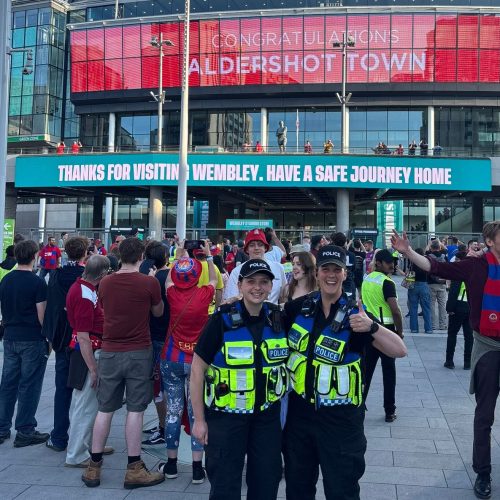
Acting Police Sergeant Hannah works in the Neighbourhood Policing Team (NPT), and as an additional skill to her core role, is one of the Operational Football Officers (OFO) for Hampshire and Isle of Wight’s Police Football Unit.
Tell us about your OFO role:
As OFOs we have two main roles when we police football games:
- Information and intelligence – to provide live and relevant information and intelligence on supporters, ensuring appropriate resource deployments by public order commanders.
- Community engagement – to act as a link between the police and a club’s supporter community, with a view to achieving increased trust and confidence between the football operation unit and supporter community.
How does your role support the force?
With the community engagement, this is where we gather intelligence which gets fed back to the DFOs (Dedicated Football Officers) to help them assess the risk of future fixtures. The intelligence can be shared within our constabulary but is also sent to the relevant forces. This helps to determine how many OFOs are required for upcoming matches.
OFOs in our force are involved in policing football from the Premier League down to the National League. This is a challenge itself with varying crowd numbers, club rivalry and the public order command structure of games.
In the National League, OFOs are often the only police contingent at football games. So, we are the first port of call for football-related disorder. Building a good working relationship with the club stewards and the safety officer will go a long way!
I mainly work Aldershot Town FC fixtures. A small town club, with a relatively large following. I go to both home and away Aldershot Town FC fixtures. Knowing your supporter community is important when working the away fixtures. The police force we visit will be reliant on our knowledge to locate fans, engage with them and help prevent disorder before/post match.
Are there any particular teams you work closely with?
As an OFO, you will work with officers from all over the force, in a variety of roles. Football policing is fun, it’s a good break from the day to day world we all work in.
We are the faces the supporters will see, week in and week out, and the ones they can seek out when away from Hampshire and the Isle of Wight.
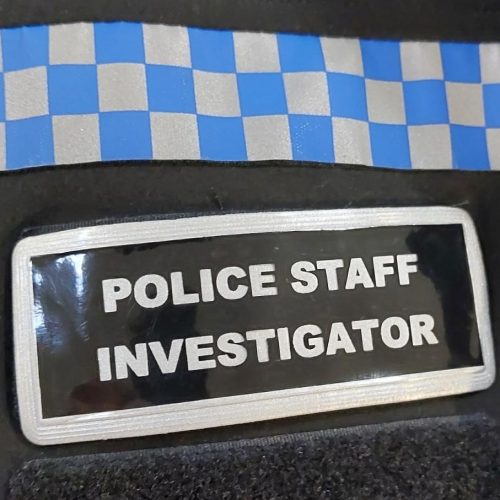
Can you tell us about your role?
The role of a Police Staff Investigator (PSI) is an incredibly varied role. I work in the Criminal Investigation Department (CID), which handles cases considered serious and complex. On any given day I could be investigating a wide array of criminal offences such as fraud, serious sexual assaults, attempted murder, kidnap, incidents involving domestic violence and so much more. I could be applying for a warrant from a judge to access premises to carry out searches, interviewing victims, witnesses and suspects, carrying out CCTV enquiries, applying forensic considerations, attending scenes of unnatural or unexpected violent deaths, building case files for submission to the Crown Prosecution Service (CPS), attending court and so much more.
What would a standard day look like for you?
No day is the same as the next and there is no such thing as a standard day. When you are allocated an investigation by a sergeant, you’ll become the Officer In Case (OIC) and you will need to consider lines of enquiry to be carried out while taking into account a wide array of factors. You may find yourself liaising with multiple departments both inside and outside the Constabulary, including members of the public and solicitors. You may find yourself completing any of the above actions.
Once you have exhausted all reasonable lines of enquiry, a sergeant will assess whether the evidence is sufficient enough to proceed to the Crown Prosecution Service. If a sergeant decides that the case should go to the CPS, you’ll then need to build a case file and pass the file to the CPS who will decide whether a suspect can be prosecuted. If a suspect is prosecuted, you may have to go to court to present any evidence. This involves answering any questions from the CPS and the defence in front of the judge, jury, defendant and anyone else inside that court room.
Are there any particular skills you require to do the role?
Taking into account the above, a PSI at the very least should act impartially and with professional curiosity. An open-minded approach is a prerequisite. Assume nothing. Believe nothing. Challenge everything. Expect the unexpected. You’ll be given training on relevant legislations, policies and procedures, using policing systems, self-defence, emergency first aid and much more.
What is the best part of the job?
I’ll ask you now to imagine being the OIC for a case and seeing it all the way to the inside of a court room and hearing the jury return with a guilty verdict. Not only have you helped to secure justice for the victim in your case, you have also helped to make the community safer for everyone. This, alongside working with incredible professionals, is some of the best parts of the job. You’ll also be given opportunities to progress, undertake additional training and join other departments across the Constabulary.
What advice would you give to someone considering becoming a PSI?
Policing is a job like no other. You’ll feel a sense of family and belonging when you join policing. You’ll need to be readily adaptable and eager and a little passion goes a long way. Change is an ongoing theme in policing and you’ll need to be ready for change at a moment’s notice. Working in policing is a harsh reality and comes with plenty of challenges, so professional perseverance is key. You’ll be joining policing at a time where public confidence nationally is low and you’ll be joining a team committed to rebuilding trust in the community. However you will quickly feel how rewarding the job is!
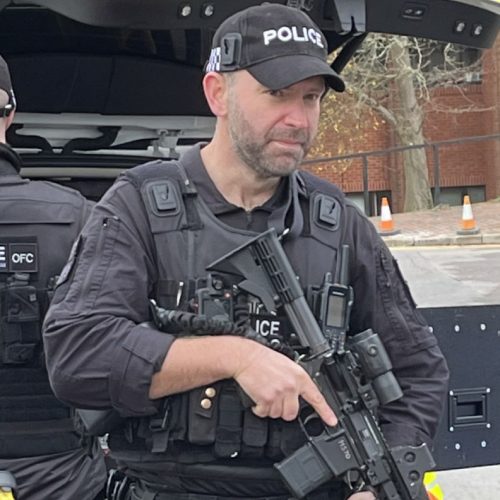
From Royal Marines to Firearms Officer: Mac’s Journey with Hampshire & Isle of Wight Constabulary
What is your Military background?
I was a Lance Corporal in the Royal Marines Commandos. I joined in 2001 and I left at the beginning of 2010.
Did that help to secure your interest in the police?
I’d always wanted to be a police officer. I think it just helped me with the process of achieving that. I’ve never really been one to sit in an office. I’ve always wanted to do something different.
Why Hampshire and Isle of Wight Constabulary?
My dad was a police officer for 44 years, and if there’s one thing you can’t get away from, it’s your genes. My dad’s mate, also a police officer, came round and had a chat and that kindled the fire, shall we say.
What’s your current role?
I’m currently a Police Constable (PC), but on the pathway to promotion to sergeant. I’m an authorised firearms officer and I work with armed response vehicles (ARVs).
What can veterans bring to roles in the police?
Discipline, conflict management, decision-making, appearance, authority, getting the job done, and we don’t take any rubbish off people.
What’s your best advice for current service leavers?
My advice would be, bring everything with you, get stuck in and be yourself but be aware of the culture change.
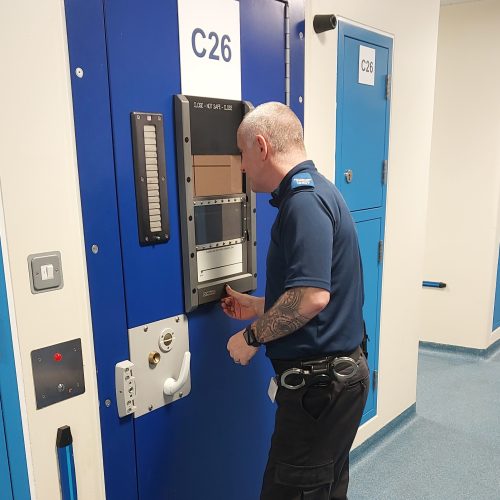
Can you tell us about your role?
My primary role is the care of the detainees in custody. This includes but is not limited to ensuring they have their medication on time, they have food and drink (which could be described as room service.) Taking photographs, fingerprints and DNA samples as well as testing for drugs (for certain offences). I will also search the male detainee when they have entered the custody environment to ensure the safety of them and my colleagues.
Are there any particular skills you require to do the role?
Being able to speak to people without judgement is a key skill in this role. Using IT systems and being competent with them.
What is the best part of your job?
The best part of the job, I believe, is having the ability to bring someone down from a heightened state to gaining their trust whereby they hold a normal conversation with you.
What would a standard day look for you?
Every day is different, there is no such thing as a standard day.
Essentially the job can be broken down into 4 parts:
- Booking in – This means you conduct a risk assessment with the detainee. Give them their rights and entitlements, gain their consent to process (fingerprints/DNA)
- Processing – This is where we take the detainee’s photograph, fingerprints, DNA and if required, dependent upon the offence, a drug test on arrest (DToA)
- Checking – This is where you get your steps in for the day. You conduct checks of the detainees in their cells ensuring they are safe and well and giving them food and drink.
- SSDO (Station Security Detention Officer) – officers on the street will inform you who they have arrested and it is up to the SSDO to load the details on to the system. You will also be required to check the Police National Computer (PNC) to gather information on the detainee.
What advice would you give to someone considering becoming a detention officer?
Come into the job with an open mind. Every single day is different and you will deal with all sorts of characters from children to pensioners in every state of mind.
Find your Place.
Find your Purpose.
Choosing a career in policing can be a big decision, often clouded by headlines or mixed opinions. In reality, it’s a career of purpose, growth, and impact, challenging but deeply rewarding. Officers are supported with wellbeing resources, flexible scheduling, and clear career progression.